


Autel AT100 Transponder Chip: A Complete Guide to Car Key Cloning
As automotive security systems continue to evolve, car keys have become far more complex than traditional mechanical designs. Today’s vehicles commonly use transponder keys or smart keys, both of which rely on an embedded transponder chip to communicate with the vehicle’s immobilizer (IMMO) system.
Although the chip itself is small, it is a critical component. If the chip is damaged, missing, or incompatible, the vehicle will not start—even if the mechanical key blade is correct. In many real-world scenarios, technicians encounter replacement key shells that do not include a chip at all, making key cloning or programming impossible.
To address these challenges, Autel introduced the AT100 Transponder Chip in 2025. This article explains what the Autel AT100 is, which key programmers it works with, and how to clone a car key using the AT100, with the Autel KM100 as a practical example.

Car Key Types and the Role of the Transponder Chip
Modern vehicles generally fall into three key categories:
- Mechanical keys, which rely solely on physical cuts
- Transponder keys, which combine a mechanical blade with an electronic chip
- Smart keys, used in most late-model vehicles, relying on encrypted wireless communication
| Both transponder keys and smart keys depend on a chip to authenticate with the vehicle’s IMMO system. Without a functioning chip, the engine will remain immobilized. This makes transponder replacement and cloning an essential service for locksmiths and automotive technicians. |
What Is the Autel AT100?
The Autel AT100 is a universal transponder chip launched by Autel in 2025. It is designed to replace or clone a wide range of original car key transponder chips and is intended for use with Autel key programming tools.
Despite its compact size, the AT100 supports advanced key functions such as cloning and immobilizer-related programming. Its affordability and broad compatibility make it a practical solution for everyday key programming work, especially when the original chip is damaged or missing.
Supported Chip Types and Technical Limitations
The Autel AT100 can replace and clone many commonly used transponder chips, including:
ID11, ID12, ID13, ID46, ID47, ID48, ID49, ID4A, ID4C, ID4D, ID5C, ID64, ID8A, ID8C, and MQB chips.
However, it is important to understand that the AT100 does not support all chip types. Certain vehicles use high-security IMMO systems that restrict cloning or require advanced cryptographic access. In these cases, reading the original key chip may require additional equipment such as the Autel XP400 or XP400 Pro, even when using an AT100-compatible programmer.
Additionally, some vehicle models do not support cloning at all and must be programmed through an all-keys-lost or dealer-level procedure instead.
AT100-Compatible Key Programmers
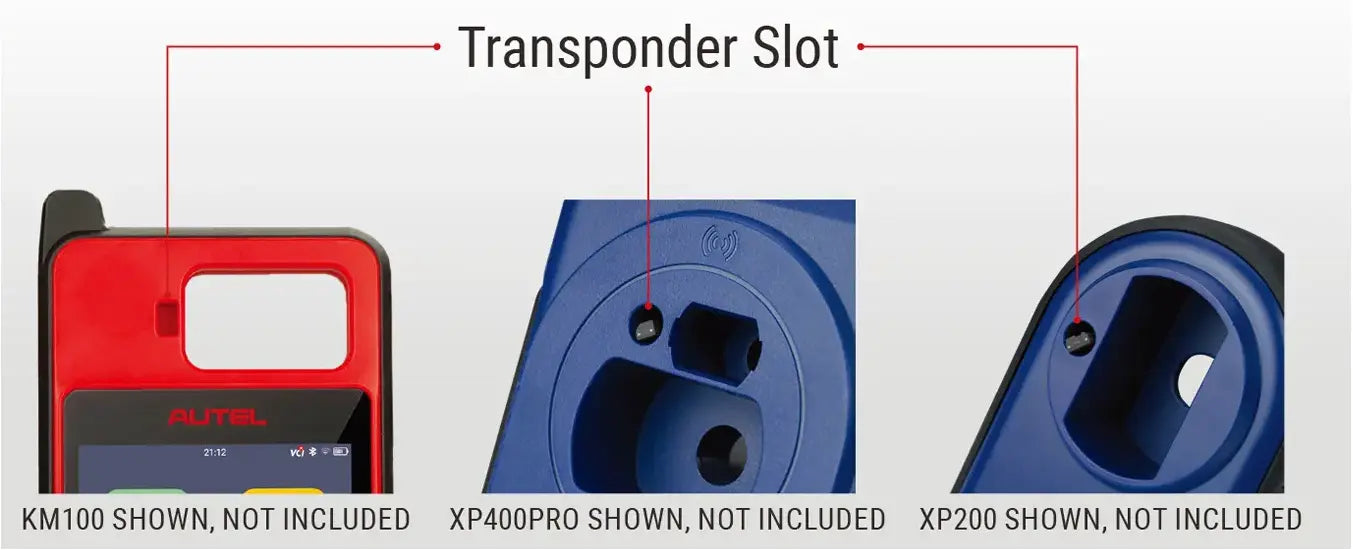
The Autel AT100 is compatible with all current Autel key programming devices, including:
Autel KM100 / KM100E
Autel IM508 / IM508S
Autel IM608 II / IM608S II / IM608 PRO II
The choice of key programmer should be based on the vehicle’s security level and the original chip type. While entry-level devices such as the KM100 are sufficient for many common cloning jobs, more complex vehicles may require advanced programmers and auxiliary tools.
It is also worth noting that if a purchased blank key already contains a compatible transponder chip, the cloning process can be completed directly without using the AT100. The AT100 is primarily needed when the blank key has no chip or an incompatible one.
How to Perform Key Cloning Using AT100?
The following instructions for key cloning using the Autel AT100 are based on the Autel KM100. The steps may differ slightly when using other key programmers.
Step 1: Correctly Connect the Key Programmer
The Autel KM100 is equipped with MaxiVCI V200, which supports wireless Bluetooth connection between the car and the key programmer via the OBD II port. Inserting the lower-level unit into the OBD II port on the driver's side establishes a connection between the Autel KM100 and the car.
Step 2: Select the Reading/Cloning Menu to Enter
Open the KM100 main interface, select the Reading/Cloning menu, place the original key to be cloned into the sensing area, read it, and determine whether it can be cloned and whether its transponder chip type is replaceable by Autel AT100.

Step 3: Cloning the Original Key and Writing It Into the AT100 Chip
Click "Clone" below and select "46 Password Calculation". Click "Start" and follow the on-screen instructions. Insert the original key into the ignition switch and turn it on. Then, bring the signal receiver of the Autel KM100 close to the ignition coil. Wait for the password calculation to complete.

After obtaining the password, place the original key and read the information. Then remove the original key, place the AT100 into the transponder slot, click Next, and wait for the cloning to complete.

Step 4: Check the AT100 Chip and Insert it into the New Key
Check the cloned AT100 chip to confirm that the information matches the original key. Then insert the Autel AT100 into the new key and test if the vehicle can be started normally.
You can refer to the video below:
How Much does It Cost to Clone a Car Key?
The price of cloning varies depending on the type of key and the level of difficulty; please refer to the table below for pricing information. If your key is more advanced, purchasing a key programming tool like the Autel KM100 might be a more cost-effective option.
| Car Key Type | Difficulty level | Price | Clone Place |
| Ordinary mechanical key | Cut only the metal part | $5–$30 | Hardware store or self-service key engraving |
| Transponder key | Using a key programmer for cloning | $50–$200 | Locksmith or Chain Key Duplication Shop |
| Smart key/keyless entry | Including Key Pairing/Programming | $150–$600+ | Dealers or Professional Locksmith |
Conclusion
The Autel AT100 transponder chip provides a reliable and cost-effective solution for car key cloning and transponder replacement. When paired with Autel key programmers such as the KM100 or IM608 series, it helps technicians efficiently handle common scenarios involving damaged chips, missing transponders, or chipless key shells.
That said, the AT100 is not a universal solution for every vehicle. Chip compatibility, IMMO security level, and tool selection all play a decisive role in successful key cloning. Understanding these factors allows locksmiths and technicians to use the AT100 effectively while avoiding unsupported or high-security scenarios.
Need Assistance?
If you encounter any issues, please contact us via:
